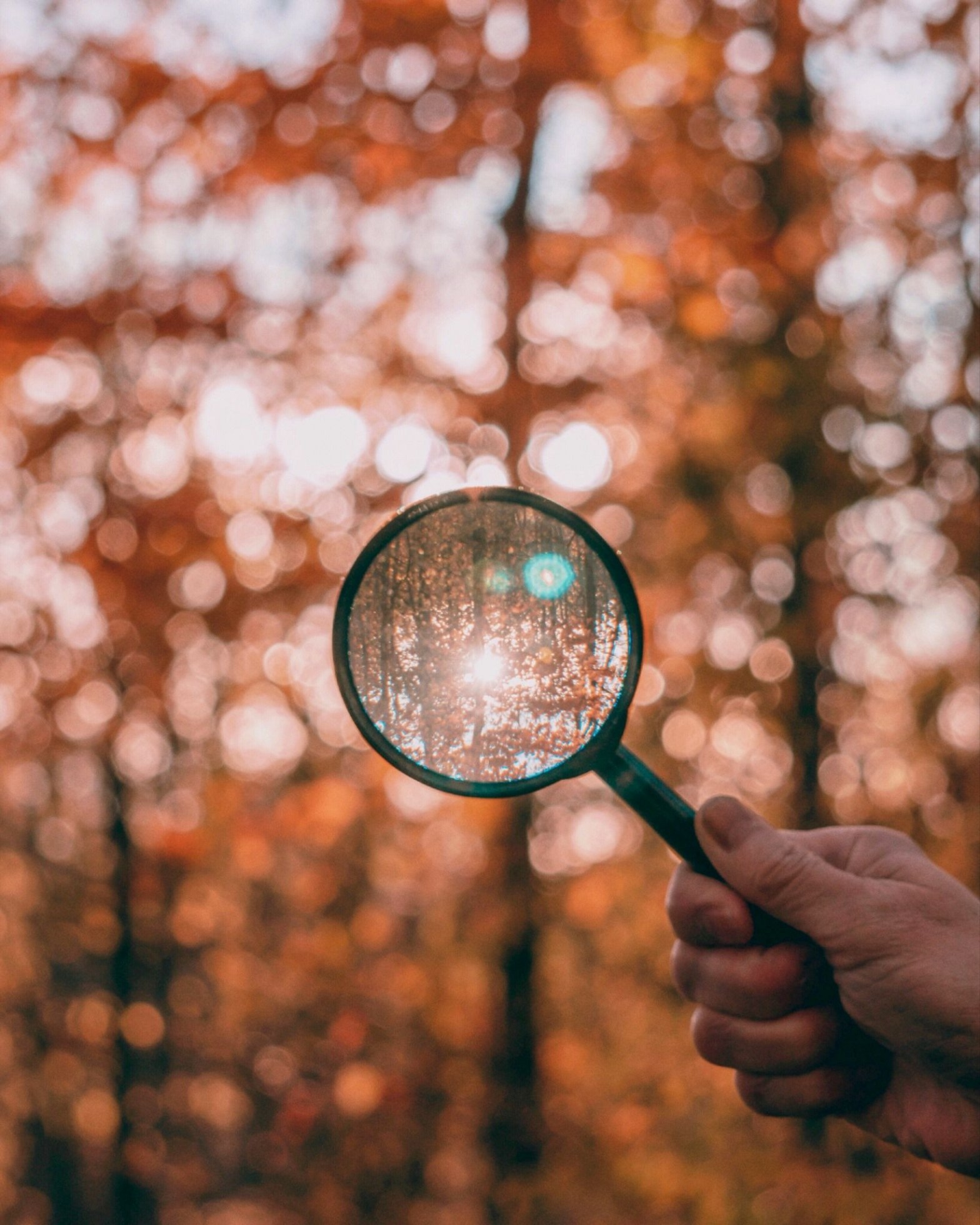
Perhaps you have seen them in the Highlights magazines in the doctor’s office or on a brain teaser app, images that are super zoomed in to the point of distortion. Is that a broccoli floret or a snake’s nobbly skin? A tile floor or a stack of colored pencils? You look for clues: texture, coloring, lighting. There is limited context to decipher the value and identity of the object in question. When we become singularly focused on what is right in front of us, we risk losing sight of the bigger picture.
In our encounter with the deep desires of our hearts, we also become aware of our own limited perspectives and scope. Have you ever had the experience of praying for guidance, only to be confused by the response? One time I brought a question to prayer on retreat. I was at peace with the response I experienced from God, although it was not my preferred direction. Just as I was ready to give my answer, the need to make the decision was removed. I felt like I had wasted my retreat, spent time in prayer on something that did not need discerning after all. What if grace comes from asking the question, rather than finding a clear answer?
The cultivation of a discerning heart takes time and practice. The art of naming our desires, and being honest with what we are holding back from God, takes courage. Even when the response we sense from God is vague, or does not pan out as we intended, any time spent listening for God is never wasted. The true grace of any discernment comes not from the specific direction that emerges, but from the opportunities to respond whole-heartedly to God. The deep desires of our hearts, even those that remain unanswered, become their own pathway to encountering God. Those “no, maybe, or not yet” responses remind us that our prayer is a moment in time, a zoomed in snapshot of our great life with God.
St. Ignatius of Loyola encountered many false starts following his conversion experience. He referred to himself as “the pilgrim” in his spiritual autobiography. One of the earliest pilgrim experiences was his thwarted desire to live and serve in the Holy Land. He sought fulfillment of his desire for “interior knowledge of the Lord, who for me has become man, that I may love him and follow him” (Spiritual Exercises no. 104). The most logical way to pursue this desire was by making a physical pilgrimage to the Holy Land. Ignatius had deeply moving experiences of consolation at sites in Bethany and elsewhere, but the political situation did not permit him to visit Nazareth or anywhere else in Galilee. Furthermore, the Franciscans charged with caring for the Christian sites did not allow him to remain long and ordered him to return to Europe.
A wasted discernment? Not at all. The pilgrim desire was still deeply a part of who Ignatius was, and the man he would become. Ignatius the pilgrim shaped the formation of the Society of Jesus, the sharing of the Spiritual Exercises, and the many graces that ensued in his lifetime and beyond. Ignatius was being led on a pilgrimage to the center of the Church (Rome) and to support his brothers in the missionary fields of their time. God took the deep desire of Ignatius’ heart and grew it into something lasting and meaningful.
My own “Holy Land” experience came shortly after my oldest child’s birth. An Ignatian ministry I was very involved with had planned a pilgrimage in the footsteps of St. Ignatius that included many Ignatian sites, a retreat at Loyola, and time walking the Camino de Santiago. The “dream trip” was scheduled for just a few months after my baby was due to be born. As I sat at home with my newborn, there was a part of me that knew I was exactly where I was meant to be. I was living into a new reality of my personal vocation, but there was also a sense of loss. No matter how much I desired the opportunity to embark on a once-in-a-lifetime pilgrimage, the deeper yes was to the new person before me.
In calling me to motherhood, God did not take away the desire for greater spiritual depth, but transformed its expression into something new. My pilgrimage was not along the dusty roads of Spain, but within my own family. I thought of Jesus’ words to Thomas, “Have you come to believe because you have seen me. Blessed are those who have not seen and have believed.” John 20:29. I believe in the living Christ not because I have walked the streets of Galilee, but because I have encountered Him in my own life: on retreat, in travel, in meeting Christ through different people and communities.
The famous prayer, “Prophets of a Future Not Our Own” reminds us that “The kingdom is not only beyond our efforts, it is even beyond our vision.” We each play our small part in living out the Gospel, one zoomed in moment at a time. I take joy and comfort that my part is small, and Christ’s vision is so much bigger than the portion before my eyes.
Going Deeper
Four Facts about Ignatius That Give us Hope

